ハイコンテントスクリーニング (High Content Screening)

CSTは、創薬研究者の利便性に考慮したセルベースアッセイ用の試薬とキットを拡充してまいります。 セルベースの一次スクリーニングあるいはセルベースの二次アッセイでご使用いただける、お客様のニーズに合った活性化特異的抗体、Total抗体、基質、アッセイキットを取り揃えております。さらに、自動セルベースアッセイのような免疫蛍光染色 (IF) アプリケーションで検証済みの700種以上の抗体の他、特定の伝達経路の研究用に、ホールセルアッセイ向けにあらかじめ最適化した抗体パネルであるPathScan® Multi-Target HCAキットもございます。
詳細は、info@cstj.co.jpへお問い合わせください。

Multi-Target HCA Kits

PathScan® Multi-Target HCA Kits allow the user to assay eight signaling molecules grouped by pathway or biological process.

View PathScan® Multi-Target HCA Kits.

ハイコンテントスクリーニング (HCS) 社内データ

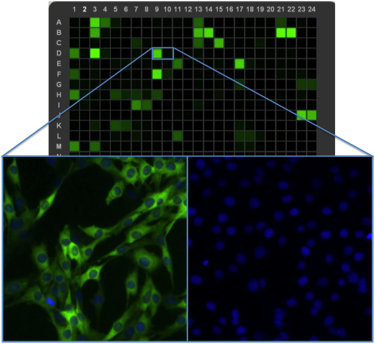
Acumen® eX3 (*TTP LabTech, www.ttplabtech.com/products/acumen/) は、HCS用のレーザースキャニング蛍光マイクロプレートサイトメーターです。CSTでは、IF用の活性化特異的抗体とTotal抗体の社内試験にこのハイコンテントプラットフォームを使用しています。シグナル伝達経路のプロファイリングはexample Aを、システムバイオロジーのプロファイリングはexample Bをご参照ください。

Example A. Single Pathway Profiling: A MAPK pathway inhibitor was tested in HeLa cells with anisomycin stimulation. Three downstream endpoints (phospho-CREB, phospho-Akt, and phospho-HSP27) were chosen to assess the efficacy of the inhibitor. Phospho-Rb and cleaved caspase-3 were also used to examine the effect of the inhibitor on proliferation and apoptosis, respectively. Cells were grown and treated in 96-well plates and labeled with CST antibodies. Plates were analyzed in-house on an Acumen® eX3 high content platform.

With and without Inhibitors MAPK pathway inhibitor

The MAPK inhibitor inhibited cellular signaling as evidenced by the decrease in phospho-Akt and phospho-HSP27 levels (see IC50 values and graphs above), while not increasing toxicity (see minimal change in phospho-Rb and cleaved caspase-3 levels above).

Example B. Systems Biology Profiling: Antibody array data from the Bcr/Abl-positive K562 and Bcr/Abl-negative SEM cell lines treated with dasatinib and imatinib. Cells were grown and treated in 96-well plates and labeled with a panel of 96 CST antibodies. Plates were analyzed in-house on an Acumen® eX3 high content platform and a high throughput flow cytometer.

Cell-based Assay Fluorescence

Responses were reported as either a decrease (red) or increase (green) in fluorescence intensity compared to vehicle. Both drugs inhibited Bcr/Abl-specific signaling pathways in K562 but not SEM cells.

15 inhibited targets - imatinib 15 inhibited targets - dasatinib

Responses of the 96 endpoints were sorted according to percent inhibition as compared to vehicle. The top 15 inhibited targets are represented in these graphs (imatinib-top, dasatinib-bottom). The magnitude of the response and the targets affected were slightly different between the two compounds.

*Data may be generated with methods/devices/compositions requiring a license to relevant third party intellectual property rights.

Product Pathways

Tools

Applications